Introduction
Bitcoin and altcoins are heading into Q4 2026 with investors searching for the catalysts that could support another period of crypto market growth. Price momentum matters, but sustainable rallies usually need more than enthusiastic traders and a few green candles. Global liquidity, institutional demand, Bitcoin market structure, blockchain adoption, and changing risk appetite can all influence where the market goes next.
For investors, the more useful question isn’t simply whether Bitcoin and altcoins will rise during Q4. It is which conditions could create a supportive environment and how to recognize them as they develop. Bitcoin may continue setting the tone, while Ethereum and other altcoins could respond differently as capital moves through the market. By tracking several key indicators instead of relying on a single prediction, you can build a clearer picture of Q4 2026’s potential opportunities and risks.
Key Takeaways
- Bitcoin demand: Strong spot buying and sustained capital inflows could help support the wider crypto market.
- Global liquidity: Improving financial conditions may increase investor appetite for higher-risk assets.
- Institutional participation: Continued institutional demand could deepen crypto liquidity and influence Bitcoin’s market structure.
- Altcoin rotation: Capital may move toward Ethereum and selected altcoins if risk appetite broadens.
- On-chain activity: Growing users, transactions, and network liquidity could help confirm stronger fundamentals.
- Market risk: Excessive leverage and speculative positioning could quickly interrupt bullish momentum.
Bitcoin Could Remain the Market’s Main Driver
Bitcoin remains a central reference point for the cryptocurrency market. Although thousands of digital assets now trade globally, BTC price action often influences overall investor confidence and risk appetite.
A constructive Q4 environment could develop if Bitcoin combines stronger demand with healthy market structure. Investors can watch spot trading volume, exchange balances, long-term holder activity, institutional investment flows, and derivatives positioning for clues.
The source of a rally matters. Bitcoin climbing because of consistent spot demand presents a different market setup from BTC rising primarily because leveraged traders are aggressively increasing futures positions.
If Bitcoin establishes stronger momentum without excessive leverage, confidence could eventually spread to Ethereum and other crypto assets. However, sharp BTC volatility can also drain liquidity from altcoins as traders move toward the market’s largest cryptocurrency.
Institutional Capital and Bitcoin Demand
Institutional participation has become increasingly important to Bitcoin’s market structure. Professional investors can access cryptocurrency exposure through a range of regulated products and trading infrastructure, making capital flows an important indicator to monitor.
Investors can pay attention to:
- Flows into regulated Bitcoin investment products
- Institutional trading volumes
- Corporate treasury activity
- Bitcoin custody developments
- Futures and options positioning
- Spot-market buying pressure
Sustained capital inflows could provide stronger support than isolated institutional announcements. A company discussing blockchain technology at a conference, for example, isn’t necessarily the same thing as meaningful capital entering Bitcoin.
Large investors can also hedge, rebalance, and reduce positions. Institutional participation should therefore not automatically be considered bullish.
The more useful signal is whether consistent professional demand coincides with healthy spot volume and resilient Bitcoin price action. When multiple indicators strengthen together, investors gain better evidence that market demand is broadening rather than depending on short-term speculation.
Global Liquidity Could Shape Q4 Crypto Performance
Crypto markets don’t operate separately from the global financial system. Interest rates, bond yields, currency conditions, credit availability, and broader liquidity can influence whether investors are willing to allocate capital toward volatile assets.
When financial conditions become more supportive, investors may increase exposure to risk assets. Conversely, tighter conditions can make cash and fixed-income investments comparatively more attractive while reducing speculative demand.
Q4 investors should therefore watch central-bank communication, inflation trends, interest-rate expectations, and changes in financial-market liquidity.
Importantly, markets tend to trade on expectations. Bitcoin could respond to anticipated policy changes before those changes actually occur.
That means waiting for a headline saying “liquidity has arrived” may be slightly optimistic. Markets aren’t known for sending polite invitations before making a move.
Stablecoins as a Crypto Liquidity Signal
Stablecoins provide another way to evaluate liquidity within cryptocurrency markets. Because they are widely used for trading, settlement, payments, and decentralized finance, changes in stablecoin activity can offer clues about capital moving through the crypto ecosystem.
An expanding stablecoin supply may indicate more available crypto-native liquidity, although it does not automatically mean that capital will flow into Bitcoin or altcoins.
Investors can monitor several related metrics:
| Indicator | What It Can Show |
|---|---|
| Stablecoin supply | Changes in available crypto-native liquidity |
| Exchange stablecoin balances | Capital potentially available for trading |
| Transfer volume | Changes in on-chain settlement activity |
| DeFi liquidity | Capital deployed across decentralized applications |
| Trading volume | Overall market participation |
| Lending activity | Demand for crypto-native borrowing |
Stablecoin data becomes more useful when combined with spot volume, Bitcoin demand, and blockchain activity.
If liquidity expands while trading and network usage also increase, investors may have stronger evidence of improving market conditions.
What Could Push Altcoins Higher in Q4 2026?
Altcoins generally require both liquidity and investor willingness to take additional risk. Bitcoin can absorb much of the market’s incoming capital during certain periods, leaving smaller assets behind even when BTC performs strongly.
That dynamic can change when Bitcoin becomes comparatively stable and investors begin searching for opportunities elsewhere. Capital may first rotate toward larger assets such as Ethereum before reaching medium- and smaller-cap cryptocurrencies.
Still, investors shouldn’t assume every altcoin will benefit equally.
Potential Q4 themes could include decentralized finance, tokenized real-world assets, stablecoin infrastructure, blockchain scaling, decentralized physical infrastructure, privacy technology, and projects connecting blockchain applications with artificial intelligence.
The critical factor is whether individual ecosystems demonstrate meaningful adoption. Users, transaction activity, developer participation, liquidity, protocol revenue, and token economics can help investors separate stronger projects from temporary narratives.
Signs That an Altcoin Rotation Is Beginning
An altcoin rotation occurs when capital increasingly moves beyond Bitcoin into other cryptocurrencies. This can happen during periods of rising investor confidence, although the sequence and strength of each rotation can vary considerably.
Investors can watch for several possible signals:
- Bitcoin maintains a relatively stable market structure.
- Ethereum strengthens relative to Bitcoin.
- Altcoin trading volumes begin expanding.
- Participation spreads across multiple crypto sectors.
- On-chain activity increases on major blockchain networks.
- Bitcoin’s share of total crypto-market capitalization changes.
- Liquidity improves beyond the largest digital assets.
Broad participation can be particularly informative. If dozens of established assets experience increasing demand alongside stronger network usage, market conditions look different from a rally concentrated in three low-liquidity tokens.
Investors should also examine token-specific risks. Upcoming unlocks, concentrated ownership, weak liquidity, high valuations, and limited token utility can affect performance even during favorable market conditions.
An altcoin rally can lift plenty of boats, but some boats have holes. Fundamentals still matter.
Blockchain Adoption Could Strengthen the Bullish Case
Price speculation attracts attention, but underlying blockchain activity can help determine whether a rally has fundamental support. Growing stablecoin payments, decentralized finance, tokenization, gaming, infrastructure applications, and other blockchain use cases can generate genuine demand for networks.
Investors can evaluate active addresses, transaction volumes, fees, application revenue, developer activity, and capital locked or deployed within protocols.
These metrics aren’t perfect. A high transaction count, for example, doesn’t necessarily indicate economically meaningful activity. Some networks can generate large numbers of inexpensive transactions with relatively little capital involved.
The strongest evidence generally comes from several metrics improving together.
If network usage expands alongside market liquidity and investor demand, the case for sustainable growth becomes more compelling. If prices surge while underlying activity remains stagnant, investors may want to examine whether speculation is doing most of the heavy lifting.
Ethereum’s Role in a Broader Crypto Rally
Ethereum remains important when assessing whether strength is spreading beyond Bitcoin. ETH sits at the center of a large ecosystem involving decentralized finance, stablecoins, tokenization, staking, and Layer 2 scaling networks.
During Q4, investors can monitor:
- ETH spot-market demand
- Staking participation
- Ethereum network fees
- Layer 2 transaction activity
- Stablecoin settlement
- Decentralized finance usage
- ETH supply dynamics
Relative performance can provide additional context. If Ethereum begins attracting stronger demand while Bitcoin remains healthy, it may suggest investors are becoming more comfortable expanding their crypto exposure.
However, ETH performance should also be evaluated against Ethereum’s own fundamentals. Rising network usage, growing financial applications, and stronger settlement activity can provide evidence beyond simple price momentum.
Ethereum doesn’t need to follow an identical historical cycle to remain important. Its evolving ecosystem means the drivers behind ETH demand can change considerably over time.
Risks That Could Stop Bitcoin and Altcoins Moving Higher
Even when market conditions appear constructive, several factors can quickly change the Q4 outlook. Crypto remains a highly volatile asset class, and bullish sentiment can reverse rapidly.
One major warning sign is excessive leverage. When traders use borrowed capital to build increasingly aggressive positions, relatively modest price declines can trigger liquidations. Those forced sales can then accelerate the decline.
Other risks include:
- Unexpected tightening in financial conditions
- Declining global liquidity
- Rising bond yields
- Regulatory uncertainty
- Exchange or blockchain security incidents
- Large token unlocks
- Weakening network activity
- Falling spot-market demand
- Highly concentrated speculative positioning
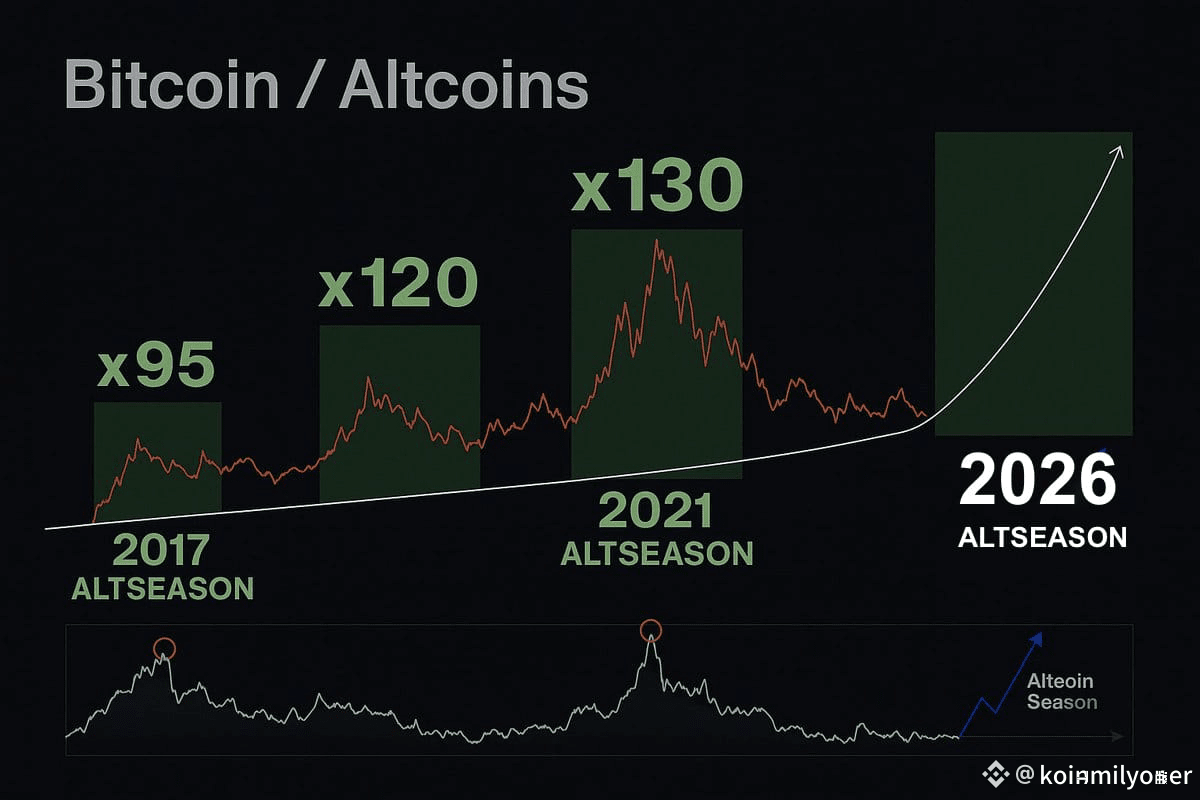
Investors should also be cautious about assuming previous crypto cycles will repeat precisely.
Historical patterns can provide context, but today’s market includes different institutional participants, investment products, regulatory frameworks, and blockchain applications. Q4 2026 may rhyme with previous cycles without following the same script.
Conclusion
Bitcoin and altcoins could benefit in Q4 2026 if several supportive forces develop together. Sustained Bitcoin spot demand, institutional capital, improving global liquidity, expanding stablecoin activity, stronger Ethereum participation, and broader blockchain adoption could all contribute to a healthier market environment. A genuine altcoin rotation would likely require liquidity to spread beyond BTC rather than remain concentrated in a few assets.
Instead of relying on an exact Bitcoin price target or assuming an altseason is guaranteed, investors can monitor these signals as conditions evolve. Pay attention to the quality of demand, network fundamentals, leverage, and liquidity alongside price. Crypto markets can move surprisingly fast, and understanding what is driving the move can be considerably more valuable than simply trying to guess the next candle.
FAQs
Does Bitcoin need to rise before altcoins can perform well?
Not always, but Bitcoin often influences broader crypto sentiment and liquidity. Some altcoins can outperform independently because of project-specific developments. A market-wide altcoin rally, however, typically requires sufficiently strong liquidity and investor appetite for higher-risk digital assets.
What is Bitcoin dominance and why do crypto investors track it?
Bitcoin dominance measures Bitcoin’s market capitalization relative to the wider cryptocurrency market. Investors use changes in this percentage as one indicator of how capital is distributed, although stablecoins, new token launches, and changing market structures mean dominance shouldn’t be interpreted alone.
Can token unlocks affect altcoin prices during Q4?
Yes. Token unlocks can increase the amount of an asset available to trade. Large releases may create additional selling pressure, particularly when early investors or team members receive tokens, although the actual impact depends on demand, liquidity, expectations, and holder behavior.
Why does trading volume matter during a crypto rally?
Trading volume helps show the level of participation behind a price movement. Rising prices accompanied by sustained volume may provide more context about demand, while sharp gains on thin volume can be less informative and potentially more vulnerable to rapid reversals.
Should investors use historical crypto cycles to predict Q4 2026?
Historical cycles can help identify recurring patterns in sentiment, liquidity, and Bitcoin market behavior, but they cannot reliably predict future performance. Changes in regulation, institutional participation, market size, and blockchain adoption mean Q4 2026 may behave differently from previous cycles.